
Last reviewed: September 14, 2026.
If you have ever searched for a well-known piracy website and found that yesterday’s address no longer works, only to see similar names appear elsewhere, you have encountered one of the defining characteristics of online piracy: the service name can survive even when individual domains do not.
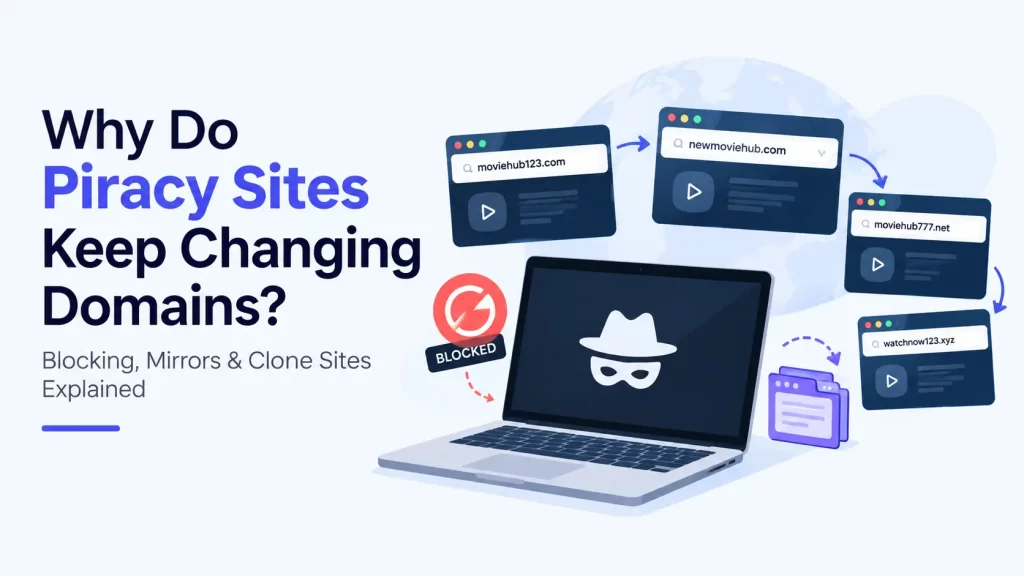
Piracy websites change domains for several reasons. Some are blocked by internet service providers following court or government directions. Others lose hosting, registrar support, or control of a domain. Operators may deliberately move to a new address, while unrelated people can create copies that imitate a familiar name. The result is a constantly changing mix of original sites, mirrors, redirects, clones, and lookalikes.
This guide explains that ecosystem without providing working piracy domains, mirror lists, or instructions for bypassing blocks. It focuses on the technical and legal reasons domains change, how courts deal with repeat versions, why a new address should not automatically be trusted, and how users can distinguish different types of sites.
Quick Answer: Why Do Piracy Sites Change Domains?
Piracy sites commonly change domains because a particular address has been blocked, suspended, abandoned, expired, or moved. In other cases, the “new” domain is not operated by the original site at all; it may be a mirror, redirect, clone, or lookalike created by someone else.
International copyright-enforcement research describes this as a recurring circumvention problem. A World Intellectual Property Organization report explains that operators may respond to blocking by moving to new domain names, changing servers or IP addresses, or creating sites that redirect users to the blocked service. Courts and regulators in multiple countries have therefore developed dynamic blocking mechanisms intended to follow new versions of the same infringing service.
| What changes? | What may be happening? |
|---|---|
| Domain name | The service may have moved to another address, or a copycat may be using a similar name. |
| IP address or server | Hosting infrastructure may have changed while the public-facing site remains similar. |
| Brand spelling | An alphanumeric or spelling variation may be intended to resemble a blocked domain. |
| Page redirects | An old or intermediary address may send visitors to a different domain. |
| Site design | A clone may copy branding or layout without being operated by the same people. |
First, What Is a Domain?
A domain name is the human-readable address used to reach a website. It is not the website itself, and it is not necessarily the server that stores or delivers the content.
This distinction is important. A service can change its domain while keeping much of its underlying infrastructure, branding, database, or content. Conversely, a completely unrelated operator can register a similar domain and imitate another site’s name or layout.
That is why a piracy brand can appear to “come back” repeatedly. What persists may be the brand, the content source, or the audience rather than one continuous technical service.
From a user’s perspective, this can make the ecosystem look simpler than it really is. Search results may show several addresses using nearly identical names, but those addresses may have different owners, hosting providers, advertising partners, privacy practices, and security risks.
The Main Reasons Piracy Sites Change Domains
1. A court or government orders access to be disabled
One of the clearest reasons is legal enforcement. Rights holders can seek orders requiring internet service providers or other intermediaries to disable access to domains associated with copyright infringement.
In India, this has become a significant part of anti-piracy enforcement. In August 2026, the Ministry of Information and Broadcasting reported that intermediaries had been directed to disable 7,393 URLs, including 1,263 websites and 4,996 Telegram channels under the government’s anti-piracy framework. The Press Information Bureau release says the Ministry has an institutional mechanism for receiving complaints from copyright holders and directing intermediaries to remove or disable access to pirated content.
A blocked domain can therefore become inaccessible to users of affected networks even though the server or service may still exist elsewhere.
2. Operators move before or after a block
WIPO describes a common circumvention pattern in which pirate operators shift to new domain names, different servers, different IP addresses, or redirect sites after blocking measures are imposed. This creates what is often described as a moving-target or “whack-a-mole” problem.
A change of domain does not necessarily require a complete rebuild of a service. The public-facing address can change while other parts of the operation remain similar. That is one reason static orders aimed at only one domain can become outdated quickly.
3. A registrar may suspend or place a domain on hold
Domain registrars and registries operate under their own terms, policies, legal obligations, and dispute procedures. A domain can become unavailable because of suspension, legal action, policy enforcement, payment problems, inaccurate registration information, or other administrative reasons.
For a visitor, these different causes can all look similar: the address that previously loaded a movie website suddenly stops resolving or displays a registrar-related notice.
4. Hosting or infrastructure can change
A domain can remain active while the server behind it changes, or the domain and server can move together. Infrastructure changes may be triggered by hosting-provider action, capacity issues, security incidents, commercial decisions, or attempts to reduce enforcement pressure.
This matters because domain blocking and IP-address blocking target different parts of the system. A site that changes infrastructure may require updated enforcement information even if its branding remains familiar.
5. Domains expire or are abandoned
Not every disappearance is an enforcement action. Domains need to be renewed. Operators may stop maintaining a site, fail to renew an address, intentionally abandon it, or move to another brand.
An expired domain can later be registered by somebody else. That means a domain that once belonged to a recognizable site might eventually host completely unrelated content. Historical reputation should therefore not be transferred automatically to a newly registered version.
6. Copycats exploit demand for the old name
When a well-known piracy site disappears, users often continue searching for it. That creates valuable search demand around phrases such as “new domain,” “official site,” or “working link.” Unrelated operators can exploit that demand by launching lookalike domains.
This is one reason a famous piracy brand can continue circulating long after the original operation has changed or disappeared. The name itself becomes traffic-generating property even when ownership is unclear.
Mirror vs Clone vs Redirect vs Proxy Site
These terms are often used interchangeably online, but they describe different concepts. Understanding the differences helps explain why piracy brands can appear under so many addresses.
| Term | Meaning in practice | Does it prove common ownership? |
|---|---|---|
| Mirror site | A copy or alternate version that substantially reproduces another site or service. | No. Similarity can be evidence, but it does not by itself prove the same operator. |
| Redirect site | An address that forwards visitors to another website or access point. | No. |
| Clone site | A site that imitates another site’s branding, layout, name, or content. | No. A clone can be entirely independent. |
| Alphanumeric variation | A domain or address that changes letters, numbers, spelling, or formatting while resembling another site. | No, although courts may examine whether it is functionally connected to an injuncted service. |
| Proxy site | An intermediary service that fetches or relays access to another site rather than simply copying it. | No. |
Legal documents often group mirrors, redirects, and alphanumeric variations together because they can provide new routes to substantially the same infringing service. In the landmark 2019 UTV Software Communication Ltd. v. 1337X.to decision, the Delhi High Court addressed what it called “hydra headed” rogue websites that multiply or resurface after blocking. The court permitted later blocking of sufficiently evidenced mirror, redirect, and alphanumeric versions without requiring rights holders to start an entirely new lawsuit each time.
A technical label should still not be treated as proof of identity. Two sites can look almost identical and yet have different operators. That distinction becomes especially important for security and privacy.
How Website Blocking Works
“Blocking a website” does not always mean deleting it from the internet. It usually means preventing or disrupting access through particular networks or intermediaries.
The European Union Intellectual Property Office describes several technical approaches used in blocking orders, including DNS blocking, IP-address blocking, and URL filtering. The method depends on the jurisdiction, court order, intermediary, and technical circumstances.
DNS blocking
The Domain Name System converts a human-readable domain into information that helps a device find the relevant internet service. With DNS blocking, an ISP or other resolver can be directed not to resolve a blocked domain normally.
IP-address blocking
An IP address identifies a network destination. Blocking can be implemented at the IP level, although shared infrastructure creates complications because multiple unrelated websites may use the same address.
URL filtering
A URL can identify a specific page or resource rather than an entire domain. Some systems can target URLs more narrowly, depending on the technology and the nature of the traffic.
Search and intermediary measures
Enforcement can also involve hosting providers, domain-name intermediaries, search services, app stores, social platforms, or other intermediaries. The exact measure depends on the applicable law and order.
For ordinary users, the practical takeaway is simple: a “blocked” site may still exist technically. The block is an access-control measure, not necessarily the destruction of every copy of the service.
Why Dynamic Injunctions Exist
Traditional blocking is static: identify a domain, obtain an order, block that domain. The problem is that a piracy service can move to a different address after the order is issued.
Dynamic injunctions are designed to address that problem. WIPO explains that they can allow new domain names, IP addresses, or URLs representing the same blocked service to be added without repeating the entire original judicial or administrative process. The objective is to keep an existing order effective when the target changes location.
The EUIPO has documented similar mechanisms across European jurisdictions. Its research notes that dynamic blocking can respond when infringing activity migrates to new aliases or access paths and that technical measures can include DNS, IP, and URL-based blocking.
Dynamic+ injunctions in India
Indian courts have developed an even broader form often described as a Dynamic+ injunction. In recent Delhi High Court matters, this can cover mirror, redirect, or alphanumeric versions of identified rogue websites and can extend protection to future copyrighted works under specified procedures.
For example, in Sony Pictures Networks India Private Limited v. Cricfree.cyou on July 1, 2026, the Delhi High Court granted an injunction against identified rogue websites and addressed mirror, redirect, and alphanumeric variations associated through factors such as name, branding, identity, or source of content.
A later July 27, 2026 order in Home Box Office Inc. v. Streamzy.to discussed the practical concern that blocked sites can move their content to new mirrors or redirects and thereby turn enforcement into a moving target. The court also emphasized safeguards against overbroad blocking, requiring evidence and preserving judicial review.
How India Handles Changing Piracy Domains
India provides a useful case study because its courts have dealt with domain-hopping piracy for years.
The 2019 UTV case
The Delhi High Court’s UTV Software Communication Ltd. v. 1337X.to decision established an important framework for identifying “rogue websites.” The court said the test should be qualitative rather than merely quantitative and considered factors such as whether a site’s primary purpose is infringement, whether operator details are masked, whether the site facilitates access to infringing material, and whether it provides instructions to circumvent blocking.
Most importantly for domain changes, the court recognized that blocked sites could resurface as mirror, redirect, or alphanumeric websites. It created a mechanism under which rights holders could submit evidence that a newly discovered website was another access point to an already injuncted rogue website.
The approach is still being used in 2026
The issue is not historical. Delhi High Court orders in 2026 continue to address mirrors, redirects, alphanumeric variations, future works, and rapid blocking of piracy services.
In Universal City Studios Productions v. Playimdb.com, decided in May 2026, the court described allegations involving embedded players, redirect mechanisms, and backend systems used to facilitate infringing content, and extended relief to associated mirror, redirect, and alphanumeric websites under the stated conditions.
In July 2026, Home Box Office Inc. v. Streamzy.to revisited the balance between fast action and overblocking. The court recognized that rights holders need a way to respond when infringing services move, but it also rejected an unlimited system in which private parties could block any website without appropriate verification. The order required supporting evidence and technical verification for new variants.
Government enforcement also operates alongside court orders
The Ministry of Information and Broadcasting has separately described a process under the Cinematograph Act, Information Technology Act, and Information Technology Rules for directing intermediaries to disable access to pirated film content. By August 2026, it reported thousands of disabled URLs.
Together, these mechanisms explain why India-focused piracy brands may repeatedly disappear, reappear, change addresses, or be copied by other operators.
Does a New Domain Mean the Same Operator Is Back?
No. This is one of the biggest misconceptions around piracy websites.
A new domain with the same logo, colors, layout, movie catalogue, or brand name might be related to an older site. But it might also be:
- a mirror created by the same or an associated operator;
- a third-party copy of public-facing content;
- a clone built to capture search traffic;
- a phishing or advertising site using a familiar brand;
- an abandoned domain that changed ownership; or
- a redirect service whose only purpose is to forward visitors elsewhere.
Without reliable ownership information, infrastructure evidence, or other verifiable connections, the safest conclusion is that identity is uncertain.
This is why StreamWiseInsights avoids declaring a “new official domain” simply because a site makes that claim. A self-applied “official” label is marketing, not authentication.
Why “Official New Domain” Claims Are Hard to Verify
Conventional streaming businesses make verification relatively straightforward. A licensed platform usually has an identifiable company, stable corporate website, official support, app-store publisher account, privacy policy, terms of service, billing identity, and public business presence.
Piracy sites often lack that chain of accountability. Operator information may be hidden, domains may be privacy-protected, and social accounts claiming to be “official” can themselves be copied.
The 2019 UTV decision noted that masked registration details and the use of new domains after blocking could be relevant when assessing rogue websites. More recent cases continue to recognize association through branding, identity, content source, and other evidence rather than simply trusting a domain name.
That makes domain authentication a factual investigation, not a matter of finding whichever result currently ranks first for “[site name] new link.”
How Domain Changes Create Security Risks
The constant turnover of domains does more than create inconvenience. It makes impersonation easier.
Users may trust a familiar brand instead of the actual domain
People often remember the name of a movie site but not its exact address. When the original address disappears, a user may search the brand and choose a result that looks familiar. A copycat can exploit that habit.
Clones can change the monetization model
Even if an older version mainly displayed advertisements, a clone may use more aggressive pop-ups, browser-notification prompts, fake CAPTCHA pages, affiliate redirects, or deceptive downloads. Reputation does not automatically carry from one domain to another.
Account and payment prompts deserve extra caution
A newly discovered piracy-branded site asking for a password, social login, card number, UPI approval, or “verification” payment should not be trusted merely because the logo is recognizable.
Unknown apps and extensions create additional exposure
Some lookalike pages encourage users to install a special video player, browser extension, mobile APK, or “updated” app. Domain instability makes it difficult to verify who produced that software or whether it is connected to any earlier version of the site.
The broader lesson is that brand familiarity is not a security control. When ownership is uncertain and domains change frequently, each new site should be treated as a separate security decision.
Blocked, Down, Expired, or Gone: What Is the Difference?
Users often interpret every loading failure as “the site was blocked,” but several different things can produce a similar result.
| Situation | What it generally means |
|---|---|
| Blocked | Access is being restricted by an ISP, resolver, intermediary, or other mechanism, often following a legal or policy direction. |
| Server outage | The service is temporarily unavailable because its infrastructure is not responding normally. |
| Domain expired | The registration was not renewed or has otherwise lapsed. |
| Registrar hold/suspension | The domain is restricted at the registration level. |
| Hosting removed | The domain may still exist, but the content is no longer served from its previous infrastructure. |
| Site abandoned | The operator may have stopped maintaining the service. |
| Regional restriction | The service may be accessible in some locations but unavailable in others. |
A browser error alone usually cannot prove which explanation applies. That is why claims such as “the site was permanently shut down” or “this is the replacement domain” should be verified before being repeated.
Why Rights Holders Use Site Blocking
Rights holders often face a practical problem: the operator of an infringing website may be anonymous, located in another jurisdiction, difficult to identify, or quick to change infrastructure. Blocking orders can therefore target intermediaries that are easier to reach, such as ISPs or domain-related services.
The objective is generally not to prove that every visitor has committed infringement. The purpose is to reduce access to a service that a court or authorized body has determined meets the relevant legal standard for blocking.
The EUIPO’s research on dynamic blocking describes these injunctions as a legal remedy intended to prevent continuing infringement even when operators attempt to move the target website. WIPO likewise notes that dynamic mechanisms have developed because operators can change domains, servers, and redirects faster than a traditional one-domain-at-a-time process can respond.
Live sports make the timing problem even more severe
For live events, delayed enforcement can make a remedy almost useless because the commercial value of the broadcast is concentrated in a short period. This is one reason courts and regulators have developed faster or more dynamic blocking procedures for live sports.
The issue remains active in 2026. The EUIPO Observatory reported that 2,966 dynamic injunctions in the monitored live-event context resulted in 77,262 blocked domains and IP addresses. Dynamic injunctions remain unevenly implemented across EU Member States, but the figures show the scale at which changing domains and infrastructure are being addressed.
Does Blocking Permanently Eliminate a Piracy Service?
Not necessarily. Blocking can reduce access, raise operating costs, disrupt traffic, and make a service harder to find. But domain changes, mirrors, redirects, alternative infrastructure, and clones can limit how permanent a single blocking action is.
This is precisely why dynamic orders exist.
At the same time, the existence of circumvention does not mean blocking has no effect. Enforcement can make piracy less convenient, reduce casual discovery, disrupt advertising or monetization, and create repeated costs for operators. Effectiveness depends on the type of block, speed of updates, user behaviour, cooperation among intermediaries, and availability of legal alternatives.
There is also a balancing problem. Overbroad blocking can affect lawful websites or infrastructure. Courts therefore need procedures for verifying that a newly identified domain is actually connected to the infringing service.
The Delhi High Court’s July 2026 Streamzy.to order directly addressed this tension. It acknowledged that rights holders should not be forced to chase endlessly moving mirrors, but it also emphasized that blocking should not become an unchecked private power. The court required supporting evidence and technical verification for new variants and preserved judicial scrutiny.
What This Means for Ordinary Users
The most important practical point is that a changing domain should increase caution, not confidence.
If a familiar movie website disappears, do not assume that the first result claiming to be its “new official domain” is genuine. A new address may have different operators, ads, trackers, downloads, or security practices.
Likewise, do not assume that a browser or ISP block is merely a technical nuisance that proves nothing. In some jurisdictions, blocks are imposed under court orders or government mechanisms after copyright complaints or judicial findings. The exact legal basis depends on the country and case.
If the underlying goal is to watch a particular movie or sporting event, the lowest-risk approach is to find a licensed source through the rights holder, broadcaster, official streaming platform, or a legitimate streaming-discovery service.
This article does not provide instructions for bypassing website blocks. Privacy or networking tools do not create a copyright licence, and bypassing a technical restriction does not authenticate the destination site.
Frequently Asked Questions
Why do piracy websites keep getting new URLs?
They may change URLs after court or ISP blocking, registrar or hosting action, infrastructure changes, domain expiration, or an operator decision. Some “new URLs” are actually unrelated clones created to capture traffic from people searching for the old brand.
What is a mirror site?
A mirror is an alternate copy or access point that substantially reproduces another site or service. In copyright cases, courts may examine whether a new mirror provides access to the same infringing service as an already blocked domain.
Is a clone site the same as a mirror?
Not necessarily. A clone can imitate another site’s name, design, or content without having any operational connection to it. A mirror usually implies a closer functional copy or alternate access point, but terminology varies.
What is a redirect site?
A redirect site is an address that sends visitors to another web location. It may be used as an alternate entry point after a primary domain has been blocked or changed.
What is an alphanumeric variation?
It is a domain variation that changes letters, numbers, spelling, or formatting while remaining recognizably similar to another domain or brand. Courts sometimes include such variants in dynamic blocking procedures when evidence shows they are connected to an injuncted service.
Why not just block one piracy domain permanently?
A domain is only one access point. An operator can move to another domain or infrastructure, and unrelated clones can appear. This is why some legal systems use dynamic blocking mechanisms that can be updated when sufficiently connected replacement domains are identified.
What is a Dynamic+ injunction?
In Indian copyright litigation, Dynamic+ injunctions are court-developed remedies designed to address rapidly changing rogue websites and, in appropriate cases, future copyrighted works. Their precise scope depends on the court order and evidence presented.
Does a blocked website mean it has been deleted?
No. Blocking usually restricts access through specified intermediaries or technical methods. The underlying server or content may continue to exist elsewhere.
Does a new domain prove the original site is back?
No. Similar branding is not proof of common ownership. The new address could be a mirror, redirect, independent clone, phishing page, or an entirely unrelated site.
Are piracy-site blocks the same in every country?
No. Legal standards, procedures, responsible intermediaries, technical methods, and safeguards differ by jurisdiction. Some countries use court-ordered dynamic injunctions, while others rely on different administrative or intermediary processes.
Bottom Line
Piracy websites keep changing domains because the public address is one of the easiest parts of an online service to replace. Courts, governments, registrars, hosts, and other intermediaries can disrupt particular domains or infrastructure, while operators can respond by moving, redirecting, or resurfacing under new variations. At the same time, unrelated copycats can exploit the old brand name.
That creates a cycle: block, move, mirror, clone, identify, and block again. Dynamic injunctions were developed precisely because traditional one-domain-at-a-time enforcement struggles with this moving target.
For users, the key lesson is not how to chase the next domain. It is that every new address introduces new uncertainty about ownership, legality, privacy, and security. A familiar brand name does not authenticate a replacement site.
Sources & Further Reading
- World Intellectual Property Organization: WIPO/ACE/17/13, international approaches to online piracy and site blocking
- European Union Intellectual Property Office: Dynamic Blocking Injunctions in the EU
- EUIPO: Study on Dynamic Blocking Injunctions
- EUIPO Observatory: Combating Piracy
- Delhi High Court: UTV Software Communication Ltd. and Others v. 1337X.to and Others, April 10, 2019
- Delhi High Court: Universal City Studios Productions v. Playimdb.com, May 8, 2026
- Delhi High Court: Sony Pictures Networks India Private Limited v. Cricfree.cyou, July 1, 2026
- Delhi High Court: Home Box Office Inc. v. Streamzy.to, July 27, 2026
- Press Information Bureau, Government of India: 7,393 piracy-related URLs disabled, August 5, 2026